





Unpacking Mental Health Culture in America
America’s need for mental health care has never been greater. More than 60 million adults reported a mental illness in 2024, highlighting a gap between need and available support. Yet, with the growing mental health professional shortage, many go without care. When faced with therapists who are burnt out and not taking on new clients or a lack of insurance coverage, some Americans have turned to alternative methods to cope with their emotions and thoughts, in what has become a growing trend.
Social media outlets like Instagram and TikTok have been the source for many to turn to for mental health topics, featuring “therapy speak” — words and terms commonly used in professional psychology settings. Meanwhile, there’s been a growing rise in using AI chatbots like ChatGPT for professional mental health help. For some, this growth has been a testimony to the collapse of the stigma around mental health. People feel freer to discuss their thoughts and emotions online, allowing them to find community and assistance for issues they would previously suffer in silence over. For others, this growth can be a breeding ground for misinformation, enabling American adults to misdiagnose and utilize potentially dangerous treatment methods.
To understand how online activity has reshaped Americans’ mental health habits, we surveyed 1,000 U.S. adults. The findings show that turning to social media for support is not only becoming more common; it’s also influencing how people think and talk about mental health in their daily lives.
Key Takeaways
- Over half of Americans (51%) say they use mental health language in everyday conversation, rising to 74% of Gen Z and 68% of millennials. Nearly half (46%) say they are more open about their mental health and express their emotions better as a result.
- Nearly 1 in 3 (32%) encounter mental health language on social media, making it the top source of terminology. Gen Z (68%) and millennials (43%) encounter it the most often.
- One in three have changed how they describe their emotions after online exposure to mental health terms or trends, increasing to 50% for millennials, and 55% among AI users.
- More than 1 in 4 use “therapy speak” in conversations with their friends and family — seventy-three find it performative when online.
- Cost is the most widespread barrier to care, keeping 53% of adults and 58% of millennials from seeking help, as many turn to friends (42%), social media (39%), and forums (33%) for support.
- Roughly one in four (23%) now use AI chatbots for emotional support, led by Gen Z (44%), millennials (31%), and men (41%). Among users, 47% say it’s helped reframe their feelings, and 41% describe it as nonjudgmental.
How People Talk and Think About Mental Health
For years, mental health was a taboo topic. People were afraid to bring up concerns over their mental health due to fear of judgment and discrimination. However, more people are talking about mental health than ever before.
This shift isn’t limited to people who were already open about their mental health. Over 45% of the survey respondents said they feel more comfortable talking about mental health now than they did earlier in life. Over 50% of Americans use mental health language in their everyday conversations.
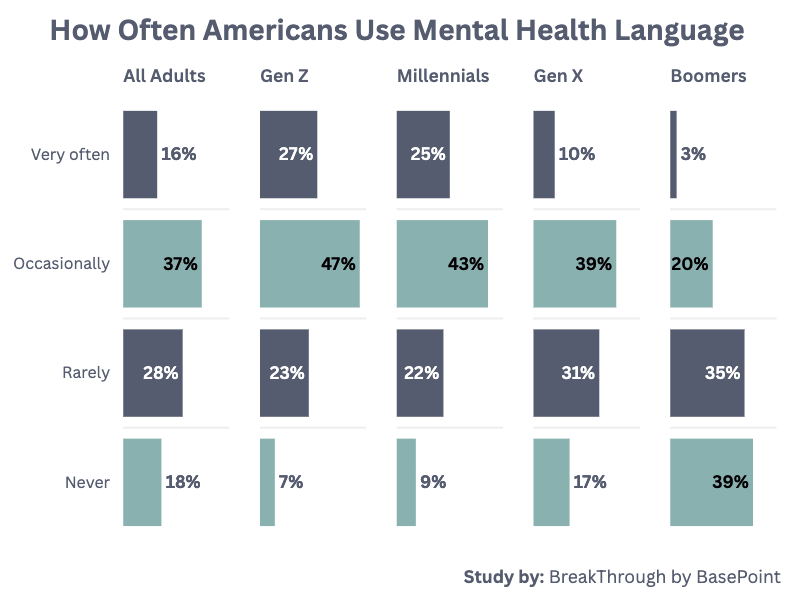
However, not all Americans talk about mental health and expose themselves to discussions about it, especially older adults. Only 23% of baby boomers say they regularly encounter and use mental health terminology. Meanwhile, 74% of Gen Z and 68% of millennials use the terminology regularly.
The survey also found mixed results in how this increased use of “therapy speak” impacted their everyday life. Of the survey respondents, 46% said talking about mental health improved how they expressed their emotions.
At the same time, not everyone feels positively about the rise of “therapy speak.” Nearly 1 in 5 adults said they avoid using this mental health terminology because it feels confusing or uncomfortable. Their responses suggest that while these conversations are becoming more common, a significant portion of Americans still finds the language inaccessible.
Where Americans Learn the Language of Mental Health
When people thought of what mental health traditionally looked and sounded like, some would think of a cartoon character sitting in a chaise lounge across from a Freudian therapist. However, mental health discussions are happening everywhere, both in the real world and online.
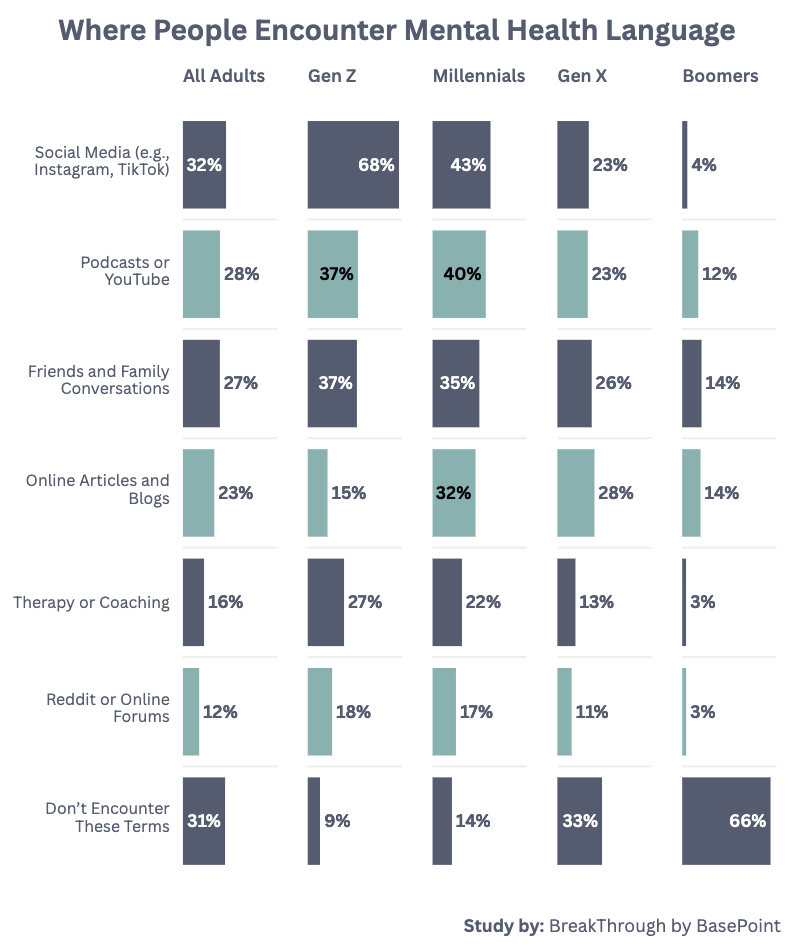
According to the survey results, 32% of Americans encounter mental health terminology on Instagram or TikTok, making social platforms the top exposure point. Even among those who use AI platforms like ChatGPT, which has recently seen a spike in therapeutic prompts, social media apps reign supreme in therapy exposure — 49% of AI-chatbot users still encounter most therapy terms on social media.
In contrast, only 27% of the respondents said they heard these terms from friends or loved ones in person, and just 16% said they encountered them through a therapist or coach.
Despite the rise in online therapy speak, many users believe that most online content may actually be problematic. Up to 73% of respondents thought the mental health language they heard online was performative or inaccurate at least some of the time. To them, these kinds of discussions weren’t a liberating exchange to talk about their experiences, but rather an inauthentic expression that may actually hinder honest conversations.
How Americans Work Through Their Feelings With the Internet
Many respondents didn’t just internalize therapy speak and keep it amongst themselves. Instead, for many, it reflected a fundamental change in their actions, particularly how they talk about it. For example, 41% changed the way they described an emotion or personal issue after encountering a similar term or trend online.
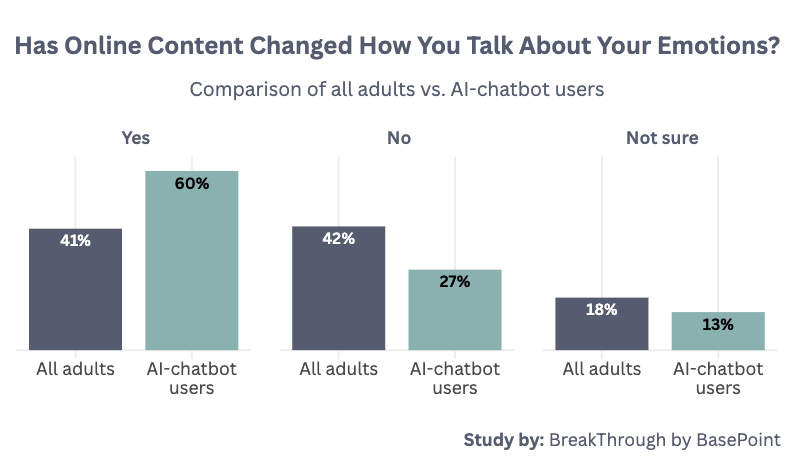
This phenomenon is more pronounced in certain groups than others. For example, 60% of AI-chatbot users said that exposure to online therapy language influenced how they describe their emotions. There is also a clear generational divide: about 50% of millennials and 41% of Gen Z reported changing the way they talk about their emotional experiences after encountering therapy speak, compared with just 29% of baby boomers. These results suggest that younger generations are generally more open to discussing mental health, while older adults continue to face lingering stigmas.
Overall, only 38% reported that therapy speak made no difference in how they communicate. For a vast majority of survey respondents, therapy speak made a positive difference in their behavior, breaking down the stigma that has lasted generations.
Where People Go for Emotional Support When They’re Not Going to Therapy
Over any kind of treatment, psychotherapy is one of the most effective. According to the American Psychological Association, 75% people attending therapy find some kind of relief within six months. However, it isn’t the only kind of treatment people are searching for in this modern age.
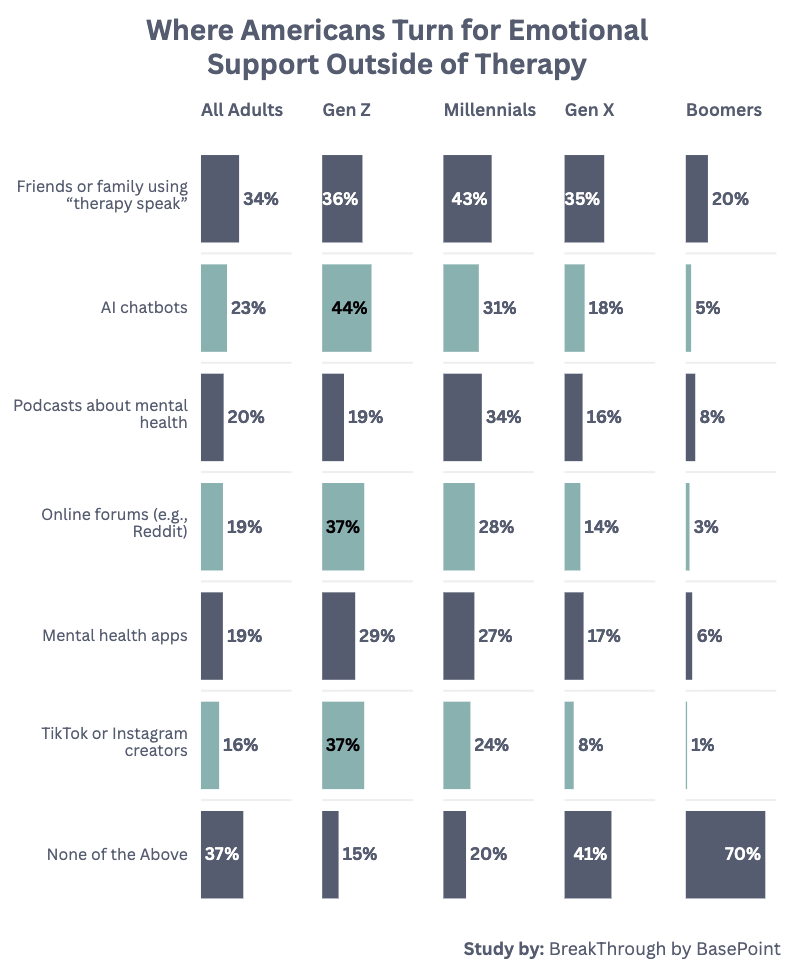
According to our survey, 63% of Americans seek alternatives for emotional support outside of therapy. At the top of the list of alternatives are friends and family who use “therapy speak” — 34% of Americans will turn to this source. Second on this list is AI chatbots. More than 1 in 5 will turn to an AI chatbot as a substitute for therapy. The other most common types of content were:
- Podcasts (20% of Americans used in the past year)
- Online forums (e.g., Reddit) (19% of Americans)
- Mental health apps like Calm or Headspace (19% of Americans used in the past year).
Younger adults are the most likely to seek out online content for emotional support. For example, 44% of Gen Z turn to AI chatbots, and 34% of millennials use podcasts to help manage their emotions. In contrast, baby boomers rarely turn to digital options, with 5% or less using AI tools and just 6% using a mental health app.
At the same time, younger people aren’t rejecting traditional therapy. Only 15% of Gen Z avoid all non-therapist emotional support options, compared with 70% of baby boomers. In many cases, younger adults’ use of online resources reflects their broader comfort with and acceptance of mental health awareness, a perspective that older generations may be less accustomed to.
What Comes First: Therapy or AI?
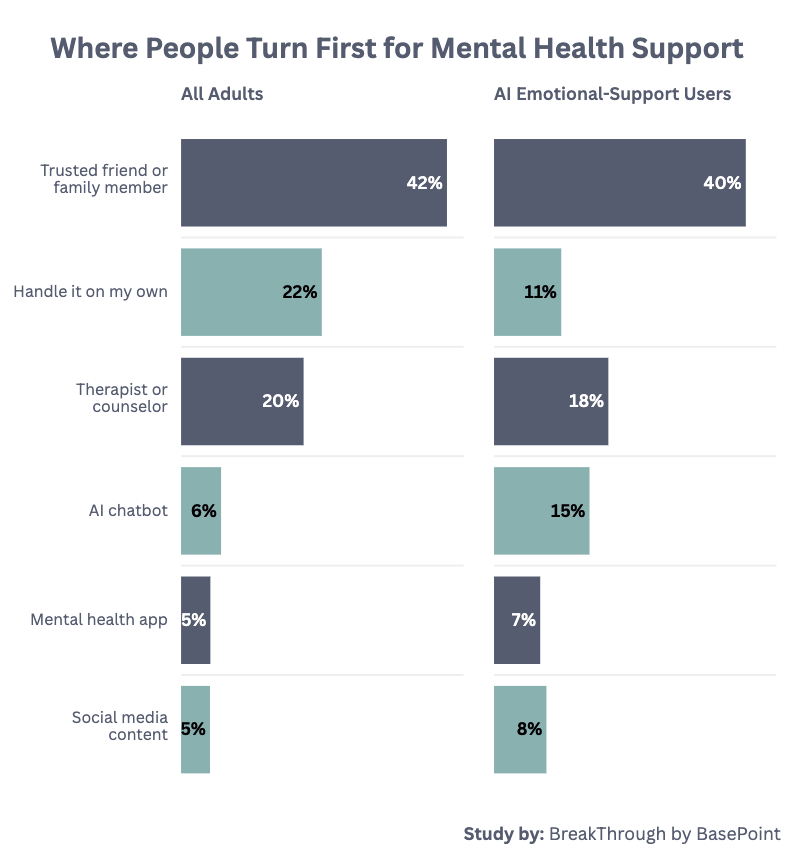
It’s no secret that many Americans delay mental health treatment for a variety of reasons. For some, the main barrier is financial: nearly 11% of U.S. adults with a mental health condition had no insurance coverage in 2024, according to the National Alliance on Mental Illness (NAMI). For others, the problem is a lack of available providers. NAMI also reports that more than 120 million adults live in areas facing a shortage of mental health professionals, leaving many without access to the care they need.
What’s Getting in the Way of Seeking Therapy
Despite the effectiveness of therapy, some barriers stand in the way of seeking actual treatment. According to a Harvard Medical School report, nearly 60% of people with mental illnesses did not seek treatment. Our survey aimed to find out why exactly they aren’t receiving the care they need, even with the growing acceptance of mental health discussions.
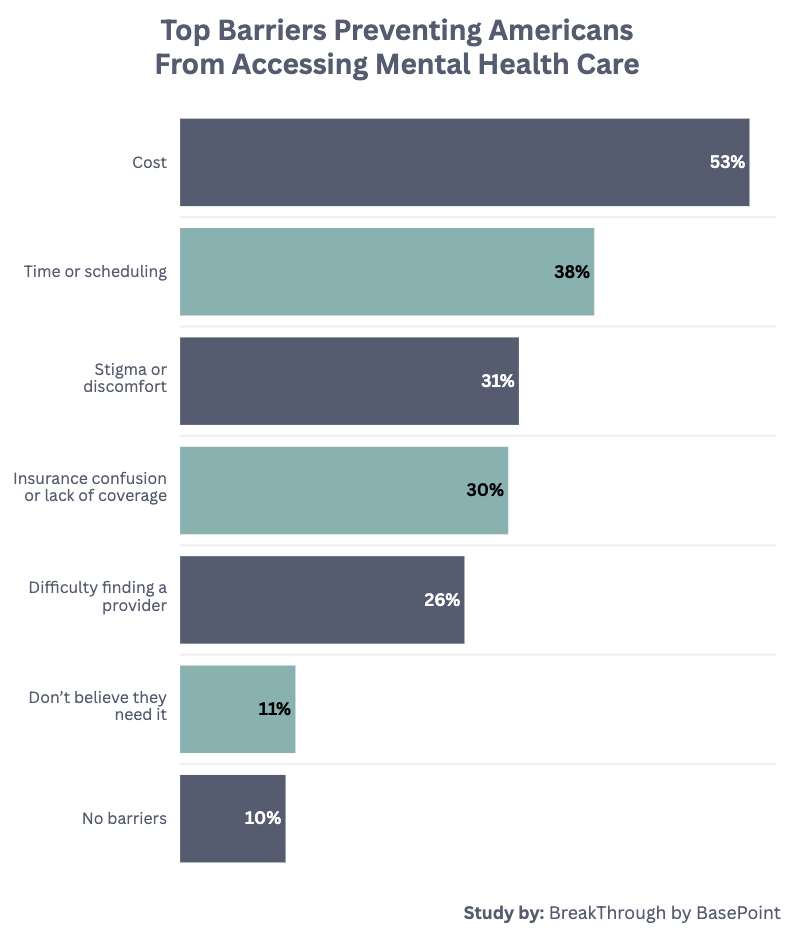
Cost was the most commonly cited barrier, with as many as 53% of respondents identifying it as the main obstacle. This was also a consistent finding among all age groups. Up to 58% of millennials and 48% of Gen Xers and baby boomers cited cost as a concern that prevented them from seeking mental health care.
Still, other barriers stood in the way, such as:
- Limited time: Of the respondents, 38% cited lack of time or scheduling conflicts as a barrier.
- Stigma: 31% of Americans felt uncomfortable, a symptom of stigma, which prevented them from receiving care.
- Lack of insurance: 30% of Americans were either confused about their insurance coverage or had limited benefits that prevented them from receiving the proper care.
- Provider shortages: Over a quarter of Americans (26%) experienced difficulty in finding an available provider, highlighting the provider shortage that exists in most of the U.S.
With all of the barriers that exist for many Americans, very few felt like they didn’t have to jump through hoops to receive the care they needed. Only 10% said they faced no barriers at all, suggesting obstacles are the norm, not the exception.
How Americans Navigate Their Emotions in a Fragmented System
If there’s one theme in these findings, it’s that Americans are redefining both the language and pathways of mental health support. Online platforms have become a major source of emotional guidance, and everyday conversations increasingly include terminology once reserved for clinical settings. This growing openness reflects meaningful progress in how mental health is discussed and understood.
But behind this cultural shift sits a more practical reality: many people simply cannot access professional care. Cost of mental health care remains the most significant obstacle, followed closely by lack of insurance, limited time, and major provider shortages. These gaps explain why the first stop for most adults isn’t a therapist. It’s a trusted friend, a personal coping strategy, or increasingly, a digital resource such as a podcast or an AI chatbot.
As mental health conversations continue to move beyond the therapist’s office, the challenge of safe and effective treatment remains. People still go without the care they need to process their emotions in a professional setting. However, if anything, this data calls awareness to the opportunities that lie in front of us.
If we bolster the resources and tools that people are already using for their mental health care, such as providing more digital options or posting more factual information online, we can meet people where they are. The future of mental health care isn’t barred off. If anything, the next chapter can be more accessible, more human, and more responsive to the realities Americans face every day.
Methodology
The study used a survey of 1,000 U.S. adults to understand the attitudes, behaviors, and actions around mental health treatment. We then stratified the data and segmented it based on age and gender.
About BasePoint BreakThrough
BasePoint BreakThrough provides outpatient behavioral services for young people, treating a wide range of mental health challenges. They are on the leading edge of providing innovative therapeutic techniques, including Cognitive Behavioral Therapy (CBT), Dialectical Behavioral Therapy (DBT), individual therapy, group therapy, and family psychoeducation.
Fair Use Statement
If you wish to use the information in this article, you may do so for non-commercial purposes only, and attribute with a link back to BasePoint BreakThrough.